

How to Be Found by AI? A 2026 AI Search Readiness Guide for Singapore SMEs
How to Be Found by AI? A 2026 AI Search Readiness Guide for Singapore SMEs
Imagine a potential customer asking an AI assistant:
“What is the best website development company for an SME in Singapore?”
Your company may have an impressive website, years of experience, and strong services. But can an AI system clearly understand what you do, who you serve, where you operate, and why customers should trust you?
Now ask yourself:
If someone asked ChatGPT, Gemini, or Perplexity to recommend a business in your industry today, would your company appear in the answer? And if it did, what information would the AI use to support that recommendation?
This question is becoming increasingly important as AI becomes part of the customer journey. A recent Singapore study found that 72% of Singaporeans have already used AI assistants to support shopping decisions, increasing to 85% among Gen Z and 80% among Millennials. Among AI users, 72% said AI helps them cut through overwhelming amounts of information, while 68% said it helps them find inspiration faster.
That means your website is increasingly being read by two audiences: people and machines. Before an AI system can potentially mention your business, it needs to discover, access, and interpret reliable information about you.
This is where an AI Search Readiness Audit becomes useful. Instead of immediately jumping into GEO or AEO tactics, MIBC starts with a more fundamental question:
Can search engines and AI systems understand my website in the first place?
Why SEO Still Matters in the AI Search Era
What is SEO?
SEO, or Search Engine Optimisation, is the process of improving a website so search engines can discover, understand and potentially rank its content for relevant searches.
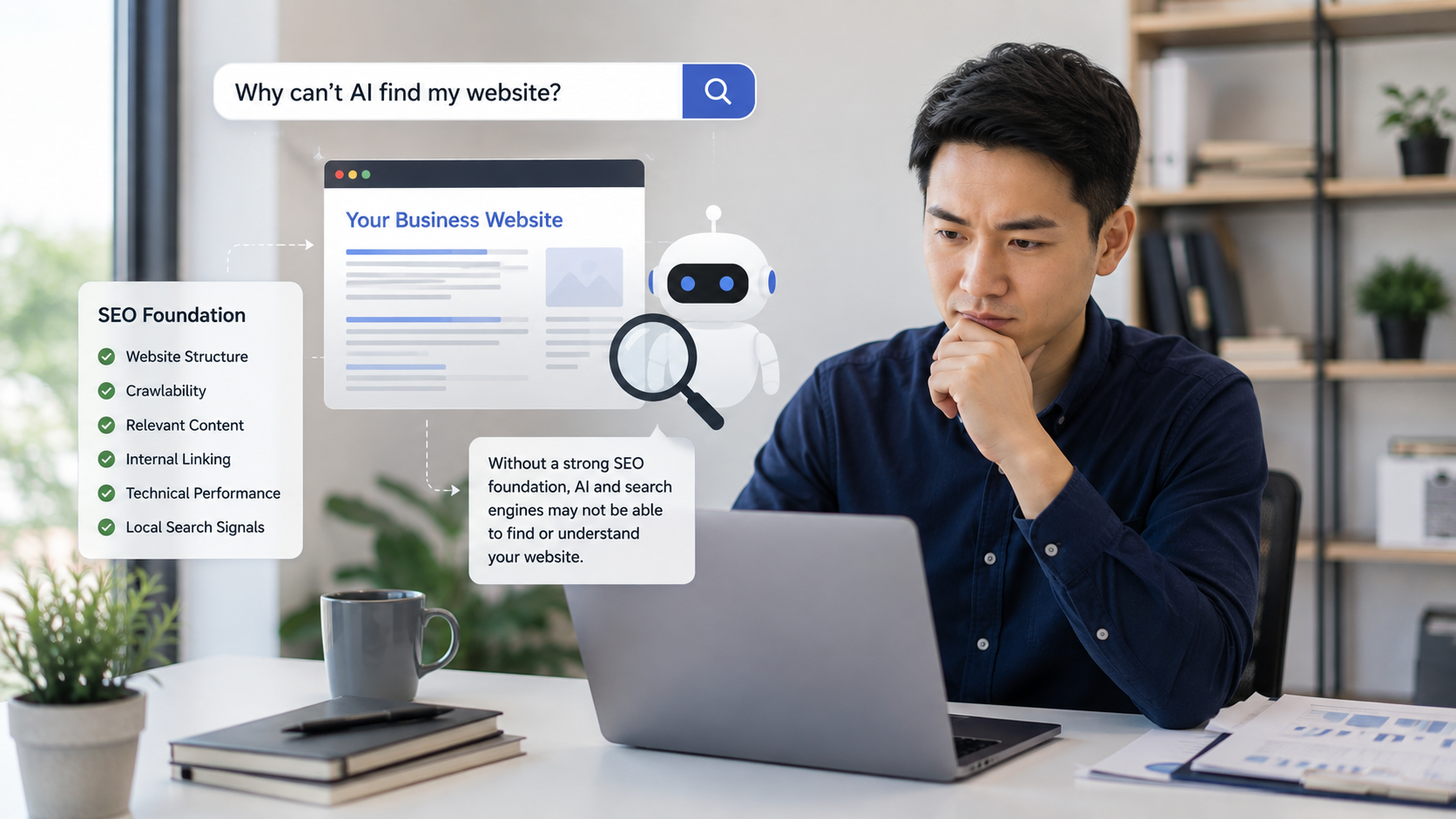
For Singapore SMEs, this includes more than adding keywords to pages. A strong SEO foundation covers website structure, crawlability, relevant content, internal linking, technical performance, local search signals and useful information that answers customer questions.
This leads to an important question: “Why can’t AI find my website?” One possible reason is that your website lacks a strong SEO foundation. If search engines have difficulty crawling your pages, understanding your content, or identifying what your business offers, AI-powered search systems may also have less useful information to work with. SEO helps create the foundation that allows your website and its information to be discovered and understood.
This becomes particularly important as AI-powered search develops. Google has explicitly stated that SEO is still relevant for generative AI search because its AI search experiences are built on Google’s core Search ranking and quality systems. Google also explains that AEO and GEO are terms used to describe work around visibility in AI search, while from Google’s perspective, optimising for generative AI search is still part of optimising the search experience.
Google also highlights familiar foundations such as crawlability, technical SEO, semantic structure, page experience, useful content and reducing duplicate content. For local businesses, Google recommends maintaining accurate Google Business Profile information because local business details can contribute to visibility in Search and AI-powered experiences.
For Singapore SMEs, this creates an important distinction. GEO and AEO can help you think about visibility in AI search, but they still depend on a website that search systems can access, understand, and evaluate. That is why MIBC starts with the SEO and website foundation before looking at AI Search Readiness.
How to Be Found by AI Search Engines
What Are GEO and AEO?
GEO, or Generative Engine Optimisation, generally refers to improving a brand’s chances of being surfaced or referenced in generative AI experiences.
AEO, or Answer Engine Optimisation, focuses on making information easier for answer engines to understand and use when responding to specific questions.
The terminology is relatively new, but the underlying challenge is familiar: your business needs to provide information that search and AI systems can discover, understand and evaluate.
1. Start With Crawlability
An AI system cannot make much use of information it cannot access.
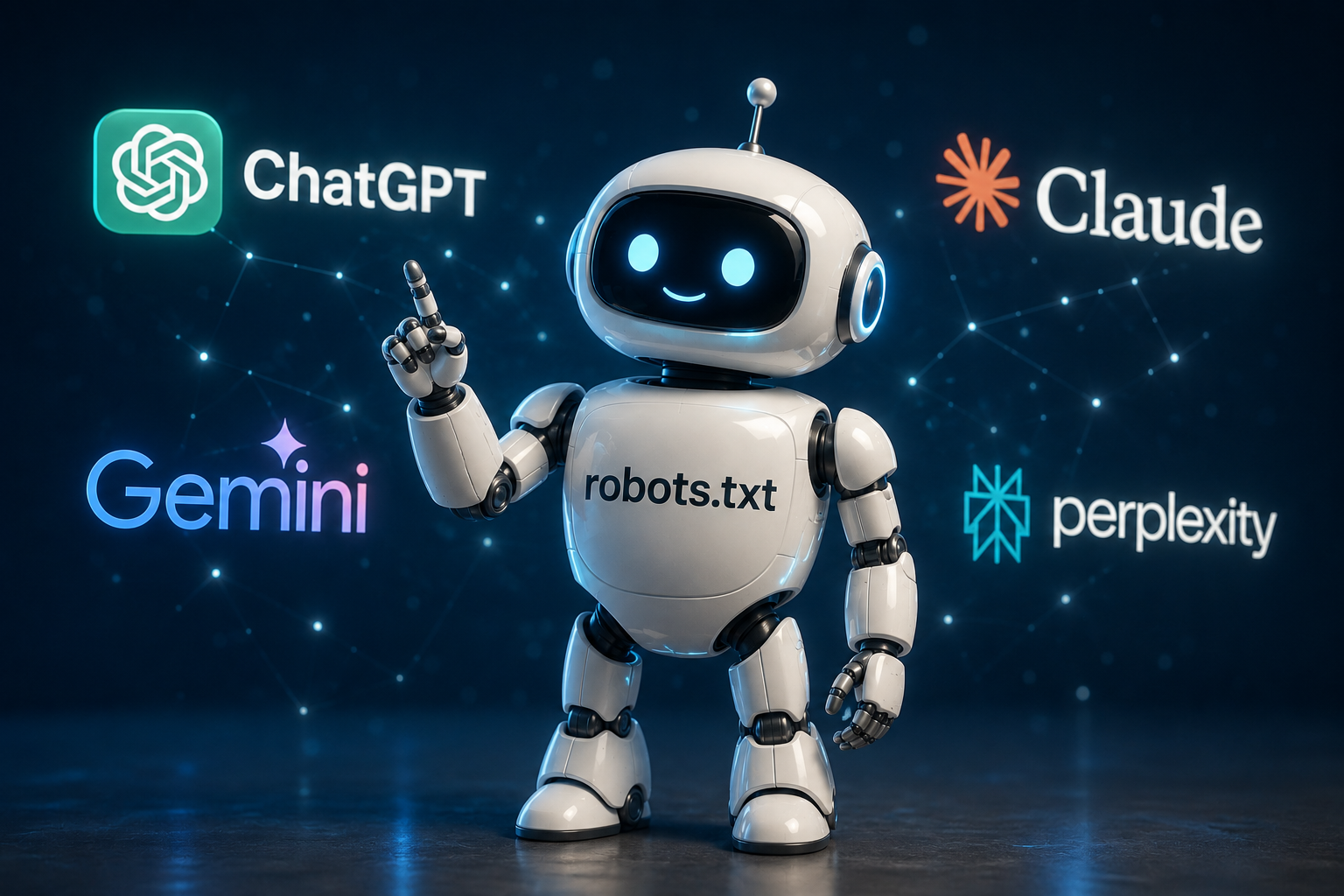
OpenAI says ChatGPT Search considers multiple factors when looking for relevant and reliable information, and website owners who want their content included should allow OAI-SearchBot to crawl their websites.
Perplexity also operates its own crawling infrastructure and explains that its crawler follows robots.txt instructions. Blocking the crawler can prevent Perplexity from indexing some or all of a website’s text content.
Anthropic similarly operates web crawlers for Claude and says its bots respect robots.txt instructions.
The systems are different, but the principle is consistent: AI needs access to information before it can potentially use that information.
2. Make Your Website Easy to Understand
A website can be technically accessible while still being difficult to interpret.
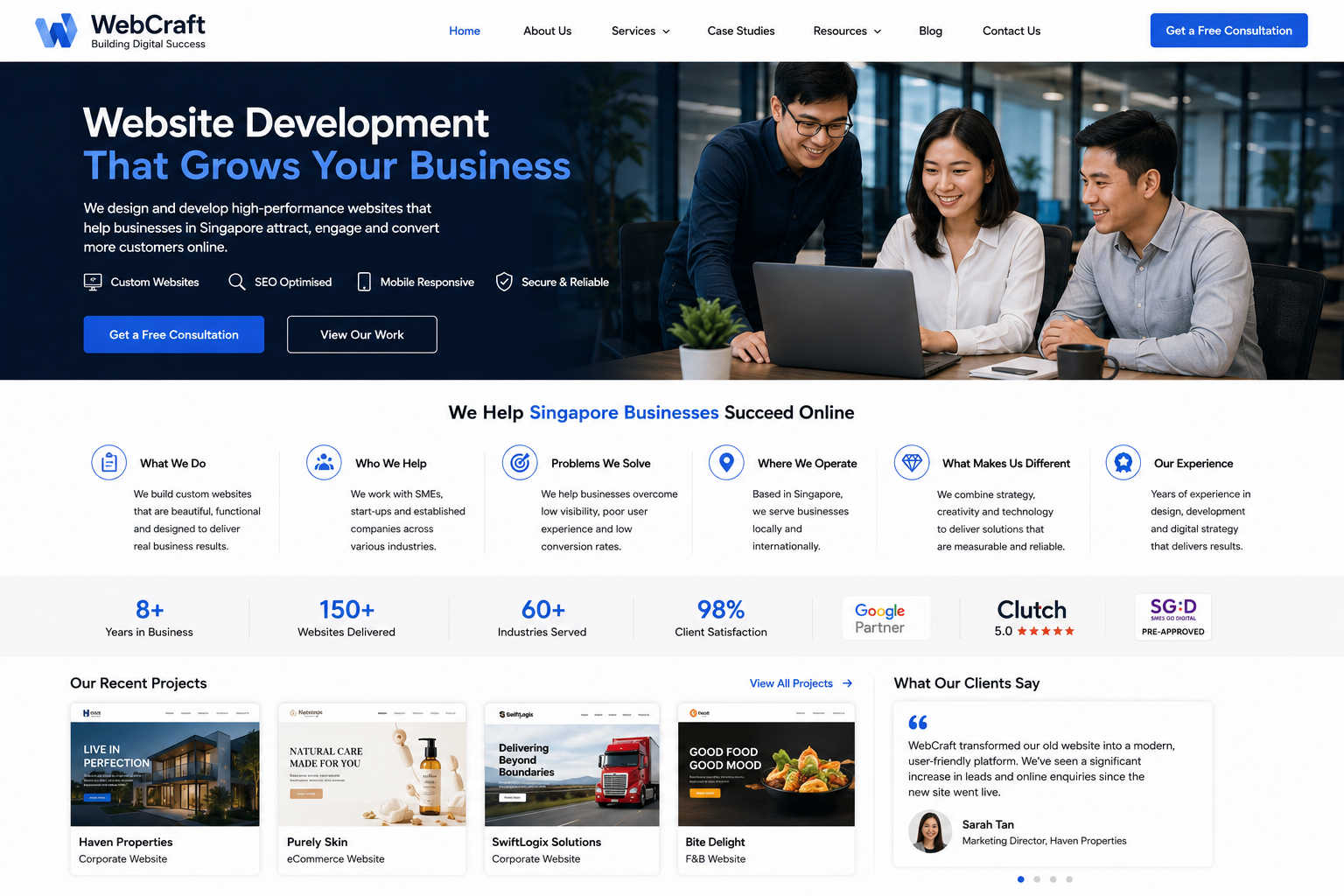
Consider a Singapore company offering website development. If its website only says “Digital Solutions” or “Transform Your Business”, an AI system has little context about the actual service.
A stronger website clearly explains:
- What the company does
- Who the service is for
- What problems it solves
- Where it operates
- What makes the company different
- What experience it has
- Which projects it has completed
- What customers say about it
This is why service pages, case studies, and trust signals matter for AI Search Readiness.
Google’s current guidance places particular emphasis on unique, first-hand, and useful content. Google specifically encourages websites to provide original perspectives and experience instead of simply reproducing information that already exists online.
3. Build Evidence Around Your Expertise
An AI-ready website should give search systems enough context to understand why your business is relevant.
For an SME, this could mean dedicated service pages, detailed case studies, customer testimonials, project results, FAQs, location information, and clear descriptions of your expertise.
For example, instead of simply saying:
“We provide SEO services.”
A stronger page might explain the industries served, the problems addressed, the SEO process, actual project experience, and measurable outcomes.
That gives both customers and search systems more information to evaluate.
4. Don’t Forget Local SEO
For Singapore businesses, AI Search Readiness should also include local visibility.
Your website should clearly communicate your Singapore location, service areas, and business information. Your Google Business Profile should also be accurate and complete.
Google specifically states that Google Business Profiles can help local businesses become visible in AI responses as well as traditional Search.
This matters when someone asks:
“Which website agency can help an SME in Singapore?”
The AI needs enough information to establish that your company is relevant to that location and query.

5. Improve the Website Itself
AI Search Readiness is not purely about content.
Google recommends crawlable content, appropriate technical structure, good page experience, mobile usability, reduced latency, and other established SEO practices for its generative AI search experiences.
This is where website revamp and SEO work connect with AI Search Readiness.
If your website has confusing navigation, missing service pages, poor mobile performance, inaccessible content, or weak technical foundations, creating another layer of GEO or AEO content may not solve the underlying problem.

How MIBC Approaches AI Search Readiness
MIBC’s approach starts with the website itself. An AI Search Readiness Check looks at key areas such as crawlability, content clarity, service-page structure, case-study evidence, basic schema implementation, local SEO signals and conversion paths. The goal is to identify anything that may make your website difficult for search engines, AI systems or potential customers to understand.
For example, an SME may have a professional-looking website with only a Home, About Us and Contact page, while its services are briefly mentioned on the homepage and there are no detailed case studies or strong trust signals. To a human visitor, the website may look complete, but search engines and AI systems have limited information to understand the company’s expertise, services and relevance.

MIBC then turns these gaps into practical improvements, such as restructuring service pages, strengthening SEO content, improving internal links, adding relevant case studies, enhancing local SEO, fixing technical issues, and improving conversion paths. Instead of treating GEO or AEO as a separate solution, we connect AI Search Readiness with SEO and website improvement, creating a stronger foundation that helps customers understand your business, search engines discover your content, and AI systems interpret the information more effectively.
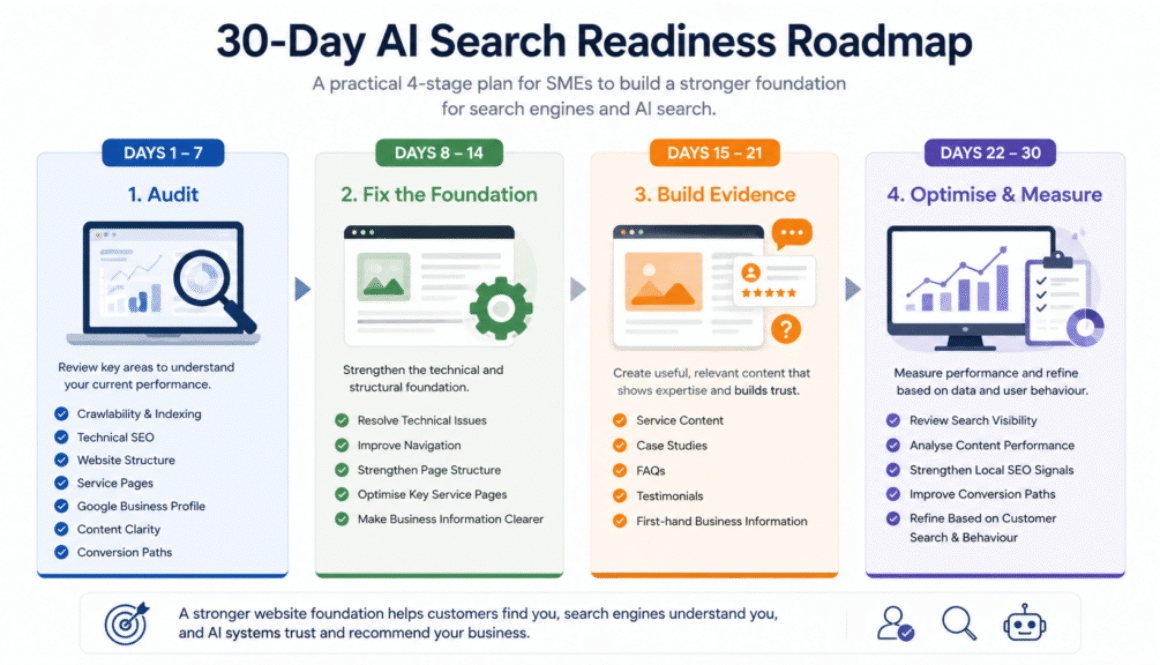
A 30-Day AI Search Readiness Roadmap
For an SME starting from scratch, the process can be broken into four practical stages.
Days 1 to 7: Audit
Review crawlability, indexing, technical SEO, website structure, service pages, Google Business Profile, content clarity and conversion paths.
Days 8 to 14: Fix the Foundation
Resolve technical issues, improve navigation, strengthen page structure, optimise important service pages and make key business information clearer.
Days 15 to 21: Build Evidence
Develop useful service content, case studies, FAQs, testimonials and first-hand business information that demonstrates expertise and answers customer questions.
Days 22 to 30: Optimise and Measure
Review search visibility, content performance, local SEO signals and conversion paths. Continue refining the website based on what customers are searching for and how they interact with the site.
This creates a much stronger foundation for traditional search and emerging AI search experiences.

Closing
AI search is changing how customers discover information, but Singapore SMEs do not need to abandon everything they already know about digital marketing.
Google says SEO remains relevant to its generative AI experiences. ChatGPT, Perplexity and Claude operate their own systems, but they still need to access and interpret information from the web.
That is why AI Search Readiness should begin with a strong SEO and website foundation.
Instead of asking only, “How do I optimise for GEO?” start with:
- Can an AI system find my website?
- Can it understand what my business does?
- Can it verify my expertise?
- Can it understand where I operate?
- Can it find enough useful information to confidently recommend my business?
If you are unsure about your website’s SEO performance or how well it is prepared for AI-powered search, MIBC can help you assess your website and identify areas that may need improvement. From SEO and website structure to content and technical performance, the first step is understanding what your website is doing well and where there are gaps.
Not sure whether your website is ready for AI search?
Your website may look professional to visitors, but there could still be SEO, crawlability, content or technical issues affecting how search engines and AI systems understand it.
Comment “AI SEARCH” below. MIBC will run a quick AI Search Readiness check and help you identify areas that may need improvement.
Q&A: AI Search Readiness for Singapore SMEs
Is SEO still important for AI search?
Yes. Google explicitly states that SEO best practices remain relevant to its generative AI search features because they are built on Google’s existing Search systems. Other AI platforms use their own retrieval systems, but accessible, useful, and understandable website content remains important.
What is GEO?
GEO stands for Generative Engine Optimisation. It generally refers to strategies intended to improve visibility within generative AI search experiences.
What is AEO?
AEO stands for Answer Engine Optimisation. It focuses on structuring information, so answer engines can better understand and use it when responding to questions.
Does GEO replace SEO?
No. Google specifically explains that, from its Search perspective, optimising for generative AI search is still SEO.
What should a Singapore SME improve first?
Start with the fundamentals: crawlability, website structure, service pages, useful content, case studies, trust signals, local SEO and conversion paths. Once these foundations are strong, more specialised AI Search optimisation becomes much more meaningful.
How can I check whether my website is AI-ready?
Start with an audit covering crawlability, content clarity, service-page structure, case-study evidence, schema basics, local SEO and conversion paths. MIBC can provide a free AI Search Readiness Check to identify the areas that need attention first.