Website Revamp vs New Website: Which Does Your Singapore Business Actually Need?
Key Summary
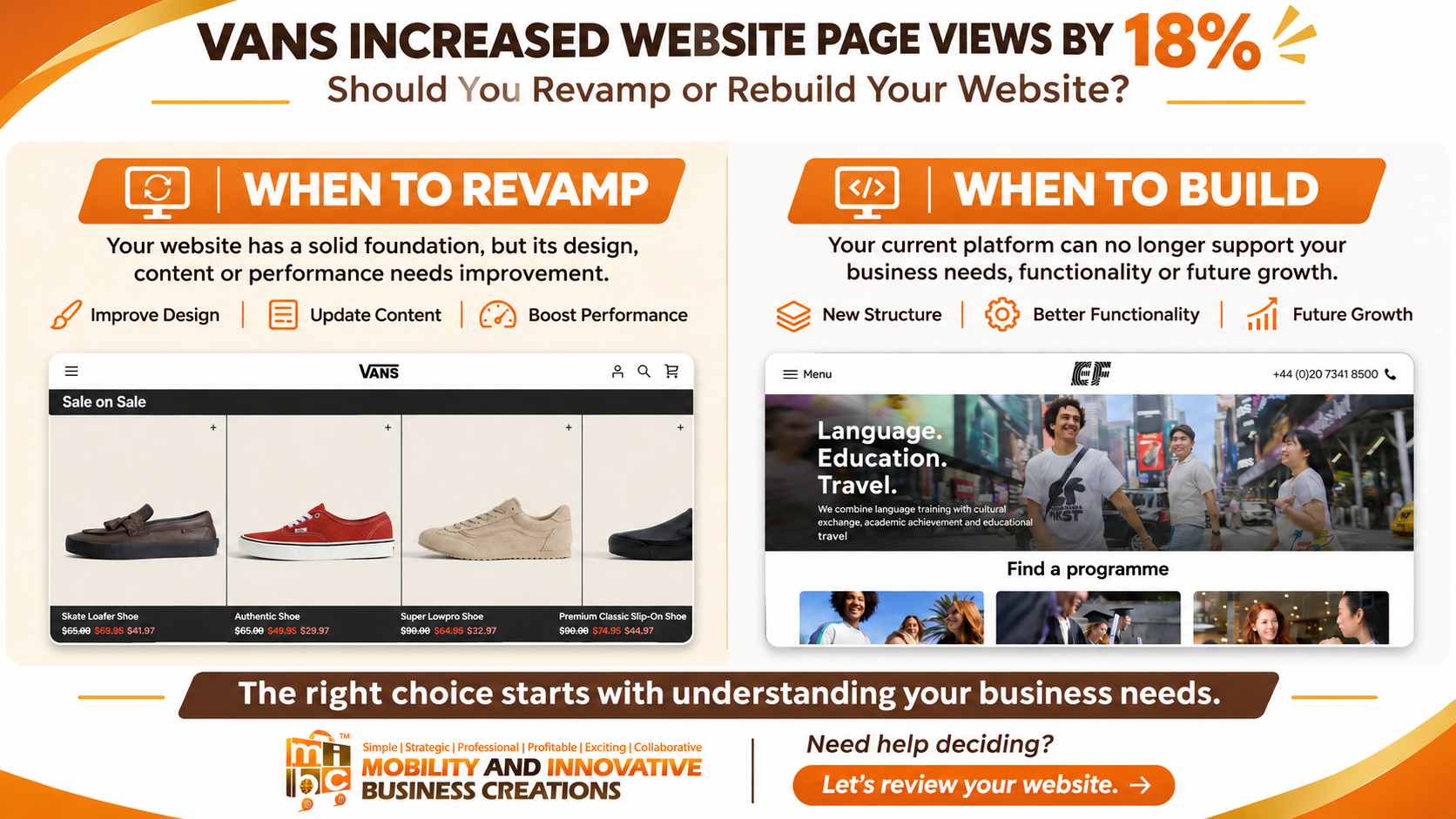
Vans increased its website page views by 18% following a website redesign and migration, while Education First (EF) developed a new website platform to support approximately 486,000 pages across 54 language variations. These two examples demonstrate how different business requirements can call for different website solutions. For Singapore SMEs, deciding between a website revamp and a new website depends on the existing platform, SEO performance, content, functionality, budget, and future business objectives. This guide explores when to improve an existing website, when to build a new one, and five important areas to evaluate before investing. Learn how to protect valuable website assets, avoid unnecessary spending and choose a website solution that supports your business growth.
Introduction
A business website often develops alongside the company it represents. A website created several years ago may have been designed to introduce the business, display its services and provide contact details. As the company grows, however, customers may expect online enquiries, product catalogues, booking functions, e-commerce features and clearer information about its expertise. This raises an important question: should you improve your existing website or invest in a completely new one?
Digital adoption across Singapore reflects why this decision deserves attention. According to IMDA’s Singapore Digital Economy Report 2025, 95.1% of SMEs adopted at least one digital area in 2024, up from 94.5% in 2023. SMEs also adopted an average of 2.3 digital areas, compared with 2.0 in 2023. As businesses incorporate more digital tools into their operations, their websites may need to evolve to support changing customer expectations and business processes.
This direction is also reflected in the refreshed Retail Industry Digital Plan introduced by Enterprise Singapore and IMDA in May 2026. Designed to guide more than 2,000 SME retailers, the plan encourages businesses to progress from foundational digital tools towards more advanced solutions. The wider lesson applies beyond retail: technology requirements change as a business grows. Your website should therefore be reviewed against what the company needs today and over the next few years.
What Can SMEs Learn from Vans and Education First About Website Revamps and New Builds?
When to Revamp: Improve a Website That Still Has a Useful Foundation
A website revamp is worth considering when the existing platform can still support your business, but its presentation, content, or user experience needs improvement. For example, your website may have useful service pages, established URLs, existing search visibility, and a working content management system. The main problems could involve outdated design, unclear navigation, slow-loading pages, or content that no longer reflects your current services. In this situation, improving the existing website may allow you to retain valuable assets while addressing specific weaknesses.

A useful example is Vans, which undertook a website redesign and migration while protecting its existing organic search visibility. Previous migrations across other websites under its parent company had resulted in significant traffic losses. For the Vans migration, the team used SEO tracking and technical safeguards, including redirects, to protect existing search performance. Following the redesign, Vans reported an 18% increase in page views, 44.3% more pages per session, a 25.2% increase in session duration, and a 22.2% reduction in bounce rate. For SMEs, the lesson is clear: an existing website may have valuable search history worth protecting when its design or structure is updated.
When to Build a New Website: Replace a Platform That Limits Business Growth
A new website may be more appropriate when the current platform creates fundamental limitations. This could include an outdated content management system, inflexible page structures, incompatible integrations, or functionality that cannot reasonably be added to the existing setup. A business entering new markets, introducing new services or managing a much larger volume of content may also need a different website architecture. Rebuilding gives the project an opportunity to establish a structure around the company’s current operations and future requirements.

Education First (EF) provides an example of this situation. Its international operations required a website platform capable of supporting extensive multilingual content. Its previous custom-built content management system had become difficult to manage at that scale. EF moved to a new website architecture that could support approximately 486,000 pages across 54 language variations. According to Storyblok’s published case study, development time for the multilingual website was reduced from four to six months to approximately eight weeks. This illustrates how a new platform can address content management and operational challenges when an existing system no longer meets the organisation’s needs
Five Areas to Evaluate Before Choosing a Website Revamp or New Build
Before deciding whether to upgrade your existing website or build a new one, assess these five areas. This helps you understand what can be retained, what needs improvement, and where a larger investment may be necessary.
- Content: What information should you keep?
Review your existing service pages, articles, images, and business information. Identify which content remains relevant, which needs updating, and which can be removed. Valuable content can often be carried forward into a revamped or newly built website. - SEO: What search visibility have you already established?
Identify pages that attract organic traffic, have backlinks, or already rank on Google. These pages are valuable digital assets. Consider their performance before changing URLs, page structures, or website content. - Functionality: Can your current platform support your requirements?
Review whether your existing website can accommodate the features your business needs, such as enquiry forms, booking systems, e-commerce functions, and third-party integrations. If the platform cannot support essential improvements, a new website may be worth considering. - Cost: What is the full investment involved?
Compare the cost of repairing and upgrading your current website with the total cost of building a new one. Include content migration, integrations, testing, SEO work, and ongoing maintenance. A lower initial quotation does not always mean lower overall expenditure. - Business Objectives: What must your website achieve in the next one to three years?
Consider your plans for business expansion, new services, customer acquisition and online transactions. If your business is entering Malaysia or other ASEAN markets, for example, your website may need to support additional languages, markets or customer journeys.
These five areas provide a practical starting point for making the decision. You can also organise your findings around four questions: What can be retained? What needs improvement? What is technically limiting the business? What must the website achieve next?
One area deserves particular attention: SEO migration. When rebuilding a website, Google recommends mapping old URLs to relevant new destinations, setting up permanent redirects, updating internal links and sitemaps, and monitoring performance through Google Search Console. Search rankings may fluctuate temporarily as Google recrawls and indexes the new pages. Without proper migration planning, businesses risk losing search visibility that took time to establish.
Make Your Website Decision Part of a Wider Business Strategy
Choosing between a website revamp and a new website is an opportunity to review how your business communicates with customers. For example, a company may update its website while introducing a new brand identity, improving its marketing materials, or preparing an offline campaign. If these activities are planned separately, customers may encounter inconsistent messages across the website, advertisements, brochures, and printed materials.
This is where the wider iKen Group ecosystem can provide an additional perspective. MIBC focuses on website development and digital solutions, iKen Design supports branding and creative design, iKen Marketing provides marketing and campaign support, while PrintStudio handles printing and physical marketing materials. Depending on the project’s requirements, these capabilities can help businesses consider how their website connects with the rest of their customer journey, from online discovery to offline engagement. Each service can be discussed according to the actual project scope.
At MIBC, we believe the first step should be understanding what your existing website can achieve and where it falls short. Our Website Revamp solution is an option for businesses that need to improve an existing website, while a new website project may be more suitable when the platform or structure needs to be replaced. Are you currently considering a website revamp or a completely new website? Comment “WEBSITE DECISION” and share your business type, current website URL, and the biggest problem you are facing. We would be glad to hear about your situation and help you consider which direction may be appropriate.
Q&A
- Is it cheaper to revamp a website or build a new one?
It depends on the website’s condition and project requirements. A revamp may cost less when the existing platform, content, and structure can be retained. A new build may require a larger initial investment, particularly when new functionality, integrations and content migration are involved. Compare the full project scope before deciding. - Will a website revamp affect my Google rankings?
It can, especially when page URLs, content or site structure change. Retaining important URLs where possible, setting up relevant permanent redirects, and monitoring Google Search Console can help manage the transition. Some temporary ranking fluctuations may still occur. - When should a business replace its existing website platform?
Consider a new platform when the current system cannot support essential business functions, has significant technical limitations or makes routine content updates unnecessarily difficult. The decision should be based on operational requirements and future plans. - Can I keep my existing website content when building a new website?
Yes. Relevant service pages, articles, images and other useful content can often be transferred or rewritten. Review each page first to decide whether it should be retained, improved, consolidated or removed. - Should I redesign my branding when revamping my website?
It depends on whether the current branding still represents your business accurately. If your positioning, target customers or services have changed, reviewing the visual identity and marketing materials alongside the website may create a more consistent customer experience.